The UK's new steel import quotas are already showing signs of pressure

In January 2027, the Carbon Border Adjustment Mechanism (CBAM) introduces another consideration for engineering-steel buyers. But the bigger question is what happens to the British manufacturers who turn steel into valuable components.
Britain needs a competitive steelmaking industry. It also needs a competitive engineering industry. Those ambitions should reinforce one another. Yet as the UK introduces new measures to protect domestic steelmaking and address the carbon cost of imports, an important commercial question is emerging:
Can British engineering manufacturers continue to obtain the steel they need, at a price that allows them to manufacture competitively?
This matters to the six-person machine shop, the repetition engineer, the specialist subcontractor and the major UK manufacturer alike.
CBAM, steel quotas and the evidence of market pressure
Two separate measures are changing the commercial environment for engineering-steel buyers.
The UK’s new steel import quotas
On 1 July 2026, the UK introduced a new steel trade measure that reduced overall tariff-free import quotas by 51% compared with the previous safeguard arrangements.
Imports exceeding the relevant quotas may face a 50% duty.
For engineering manufacturers, three customs categories are particularly relevant:
| Category | Broad product group | Examples of relevant engineering grades* |
| 12A | Certain alloy hot-rolled merchant bars | EN16, EN19, EN24, EN40B |
| 12B | Certain non-alloy hot-rolled merchant bars | EN3, EN8, EN9 |
| 27 | Certain cold-finished bars | Bright and cold-finished engineering-steel products |
These are illustrative associations, not definitive grade classifications. The correct customs category depends on the commodity code, chemistry, form and condition of the steel.
What happened before the first quarter ended?
By 14 September 2026, with 16 days remaining in the first quota quarter, reported utilisation had reached:
99.1% — Category 12B | 86.4% — Category 27
These are reported interim observations, not independently reconciled final quarter-end figures. Nevertheless, they provide a significant indication of pressure on tariff-free import capacity.
For category 12B, almost the entire reported allowance had been used before the quarter ended. That does not mean steel imports stopped. Material could still enter under other applicable allocations or, where relevant, subject to the out-of-quota duty.
But it raises a legitimate commercial question: what happens when a British manufacturer needs a particular steel grade, diameter or delivery condition and the most competitive import route becomes more expensive?
CBAM arrives on 1 January 2027
The UK’s Carbon Border Adjustment Mechanism introduces a carbon-related tax on specified imported goods, including certain iron and steel products. Its purpose is different from that of the quota system.
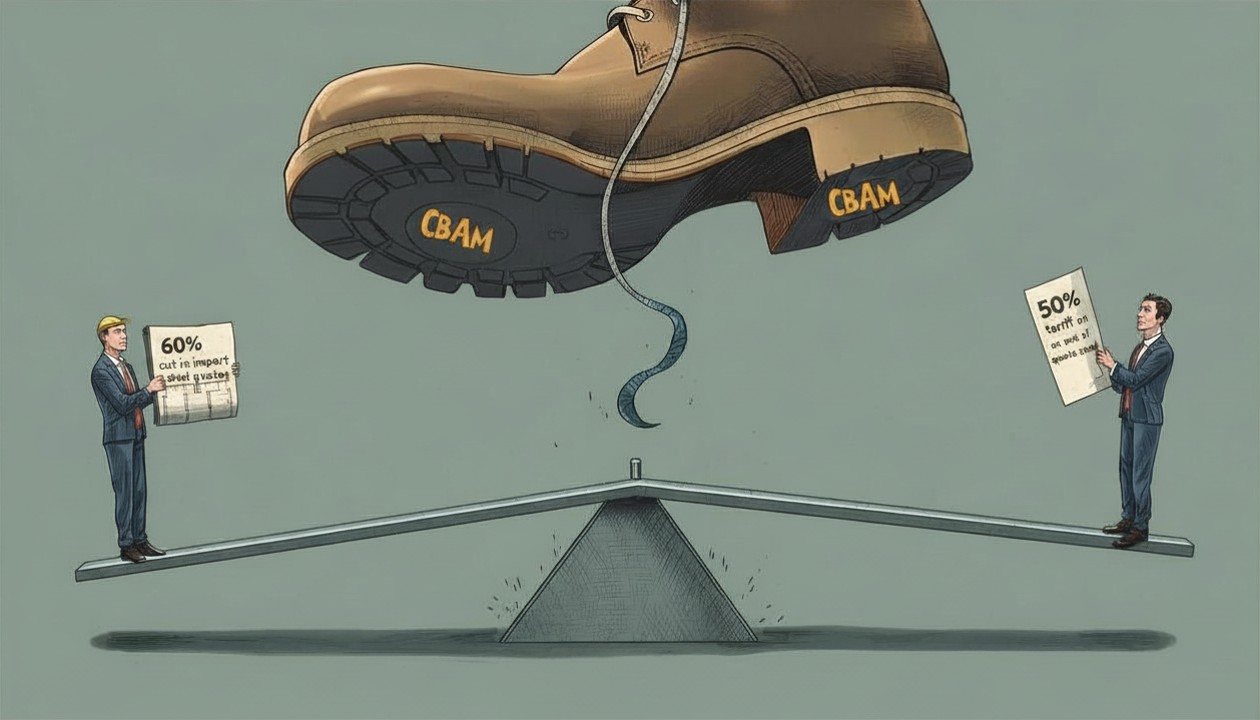
Steel quotas seek to protect domestic production from import competition. CBAM seeks to address carbon leakage by applying a carbon cost to covered imports.
The two measures operate separately, but manufacturers may experience their effects through the same purchasing decision. A business quoting a component for delivery in 2027 needs to understand whether its material price, availability and supply arrangements could change. Importantly, CBAM does not automatically apply to every engineering component or every steel purchase. The treatment depends on the relevant commodity classification, import arrangements and applicable rules.
The manufacturing question is not simply whether a policy has a legitimate objective. It is whether the combined commercial outcome helps Britain manufacture competitively.
CBAM explored What happens when CBAM and Quota's meet?
The market reaction: could Britain end up making less and importing more?
Consider a British precision engineering company quoting a repeat order. Its customer requires components manufactured from a specified grade of steel, with particular dimensional tolerances, mechanical properties and certification. The manufacturer has two broad options…
Option A: Purchase the engineering steel, machine the components in Britain and deliver the finished product.
Option B: Source an equivalent finished component from overseas, subject to the relevant import, quality and customer-approval requirements.
If the cost of importing the raw steel rises while the finished component follows different trade and carbon rules, the economics of those options may change. That does not prove manufacturers will move production overseas. There are important reasons to manufacture domestically: quality assurance, shorter supply chains, technical collaboration, delivery responsiveness and control over production.
But the possibility deserves serious examination.
Could policy encourage the import of finished components?
A manufacturer under pressure to remain competitive may review every part of its cost base. If steel becomes more expensive or less predictable to source, the business could face:
- Reduced margins on existing contracts
- Higher prices when quoting new work
- Greater working-capital requirements for forward stock
- Longer or less certain material replenishment
- Stronger competition from imported finished components
The risk is not merely that Britain imports less steel. It is that Britain might import more of the finished products it could otherwise have manufactured. This remains a commercial risk to investigate, not a demonstrated nationwide outcome.
To establish whether it is happening, we need evidence of changing material costs, lost or delayed orders, purchasing decisions, UK component production and imports of comparable finished goods.
The question we should be asking
Could measures designed to support British steelmaking inadvertently disadvantage some of the British manufacturers that use steel?
Supporting steel production and supporting engineering manufacturing should not be competing objectives.
The test is whether both can thrive.
Can Britain make the engineering steel it needs — and what manufacturing value is at stake?
A national steel-production figure does not tell a precision engineer whether the required bar is available. A manufacturer may need EN8, EN9, EN16, EN19, EN24 or EN40B in a specific diameter, condition and certified specification.
The distinction matters.
Steelmaking capacity is not the same as engineering-grade capability. Engineering-grade capability is not the same as qualified commercial supply. And qualified supply is not necessarily stock available when a machine shop needs it.
That distinction was acknowledged in Parliament on 9 September 2026.
“Some product codes cover both UK-produced and non-UK-produced grades and sizes.”
Blair McDougall MP, Parliamentary Under-Secretary of State (Minister for Reindustrialisation)
The implication is important: protecting a customs category does not necessarily mean that every engineering specification within it can be produced domestically.
UK Steel’s Key Statistics Guide 2026 reports that British crude steel production fell from approximately 6.0 million tonnes in 2023 to 2.6 million tonnes in 2025. It also indicates that domestic producers supplied roughly one-third of UK finished steel demand in 2025. These figures demonstrate the importance of rebuilding domestic capacity. They do not establish the domestic availability of every engineering grade, diameter or delivery condition.
What UK manufacturing value could be left on the table?
This brings us to the wider economic question…
When a British engineering company imports steel and machines it into a precision component, the value created is not limited to the price of the material. It includes machining, skilled labour, programming, tooling, finishing, assembly, quality assurance and engineering expertise.
Economists refer to the domestic value created through production as gross value added (GVA). If a component is manufactured in Britain, some of that value is created here. If an equivalent finished component is imported instead, more of the manufacturing value may be created elsewhere. That raises another question worth investigating:
How much additional British manufacturing value could be generated if engineering firms had reliable access to the right materials at competitive prices?
Making steel matters. Making things from steel matters too.
Britain should aspire to a stronger domestic steel industry, greater industrial resilience and lower-carbon production. It should also aspire to a thriving engineering sector capable of turning steel into high-value products. Those goals are connected.
The success of steel policy should therefore be judged not only by the tonnes produced domestically or the volume of imports restricted, but also by the ability of British manufacturers to obtain materials, win contracts, sustain employment and add value.
How much additional British manufacturing value could be generated if engineering firms had reliable access to the right materials at competitive prices?
We cannot responsibly assign a GDP or GVA loss from quota-utilisation percentages alone. To do so, we would need evidence of additional orders that could have been fulfilled, the material requirements involved, whether supply costs genuinely prevented production, and how much value would have been created domestically.
But the absence of a reliable national estimate does not make the question unimportant. Indeed, it makes the case for better measurement.
What should engineering manufacturers do before January 2027?
Engineering businesses should review their critical steel grades, sizes, specifications and likely purchasing requirements for the months ahead. For work being quoted into 2027, it is sensible to discuss material availability, delivery lead times, price validity and sourcing options early. Businesses importing directly should also establish whether the goods they purchase fall within the scope of CBAM and what obligations apply.
At High Peak Steels, we believe engineering manufacturers need practical information, reliable supply discussions and a clear understanding of the changing market. Our position is straightforward:
Britain should not have to choose between protecting steelmaking and protecting engineering manufacturing. The objective should be to make both more competitive.
Steel is what we sell. Service is what we deliver.
Discuss your engineering-steel requirements with High Peak Steels
Telephone: 01457 866911
Email: sales@highpeaksteels.com
What High Peak Steels is monitoring
Engineering Steel Insight is published by High Peak Steels, with DNA Consulting as research partner. This article draws on Chapter 4, November 2026. Quota utilisation figures quoted for 14 September 2026 are reported interim observations, not final reconciled quarter-end figures.
Principal sources: UK Government, UK Steel Trade Measure from 1 July 2026; HMRC, CBAM Policy Summary and CBAM Rates; UK Steel, Key Statistics Guide 2026; UK Parliament, written answer of 9 September 2026.
- Quota utilisation
- Engineering steel import volumes
- Material availability
- Lead times
- Government policy
- Market pricing
- Supply-chain resilience
We’ll also begin comparing the policy position with what we’re actually seeing in the engineering steel market. Because ultimately, policy only becomes meaningful to an engineer when it affects the engineering steel material you require to make the next order of components. This table shows one of the measures we’ll be monitoring in our Steel Insights. You can read more about this in Chapter 4.
Finally, if your business is affected by these challenges we’d love to hear from you. Our plan is to feed genuine insights on the market; that includes you the engineering business. You can send your comments to sales@highpeaksteels.com and these will be evaluated by our Directors for inclusion in Blog content in the coming months.
Want the deeper analysis?
Delve deeper into this topic by viewing or downloading Chapter 4 of our Engineering Steel Insight.
We’ll look at the safeguard categories in greater detail, map them against engineering steel products and High Peak Steels’ stocked grades, and examine what the emerging evidence tells us about availability, sourcing and competitiveness.
CBAM arrives in January 2027 Can UK engineering manufacturers still buy steel and manufacture competitively?
As always, we will continue to monitor developments closely and keep you informed. For customers requiring engineering-grade steels such as EN8, EN19, and EN24, we continue to support supply wherever possible despite current market pressures.
To discuss any challenges you may be facing in supply, or to discuss how High Peak Steels can support you at this critical time, call us directly on 01457 866911.
Look for our latest updates on LinkedIn, TikTok, Facebook and X.