Britain's steel policy is changing
The new UK steel trade measure has reduced tariff-free quotas, introduced a 50% tariff on steel entering above quota, and placed renewed emphasis on increasing domestic steelmaking.
But for the thousands of UK manufacturers that turn engineering steel into components, there is another question.
What does this mean for the UK manufacturer trying to make the component?
That is the question at the centre of the latest Engineering Steel Insight from High Peak Steels.
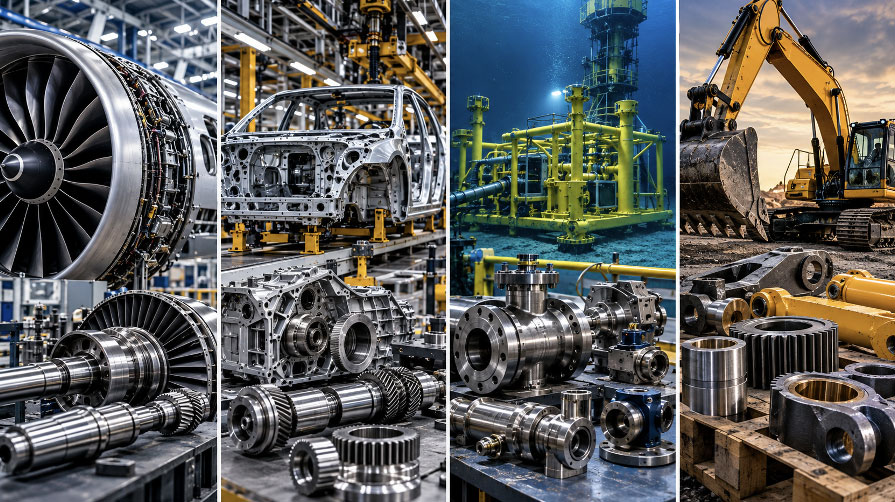
Aerospace, automotive, subsea, heavy equipment, defence, energy and advanced machinery all depend upon engineered components. Where these components are made is critical to UK engineering success.
The 30-second insight
Protecting viable UK steelmaking matters. But the success of steel policy should also be visible further down the supply chain. A UK manufacturer needs the right grade, quality, form and condition, available when required and at a price that allows the component to be manufactured competitively in Britain.
The objective should therefore not simply be to reduce steel imports. It should be to increase the amount of value Britain manufactures from steel.
What does an engineer actually need from the steel supply chain?
An engineer rarely begins with the question: Where was this tonne of steel produced?
The immediate production questions are more practical. Is the correct grade available? Is it the right diameter or section? Is it supplied in the required condition? Does it meet the necessary specification and certification? Can it be delivered when production requires it? And can the resulting component still be manufactured competitively?
This gives us a simple hierarchy:
Right material → Right quality → Available when required → Competitive price → Ability to manufacture competitively
Increasing UK steelmaking capability can strengthen that chain considerably. But there is an important distinction: “Steel that can be made in the UK” compared with, “Steel that can be bought by a UK engineer when required” are not necessarily the same test for UK productivity.
Engineering Steel Safeguards: Which Grades Are Actually Affected?
What are the first-quarter steel quotas telling engineering-steel buyers?
One of the difficulties for engineers is that the safeguard system does not work in familiar engineering grades such as EN8, EN9, EN19 or EN24.
It works through customs commodity codes and product categories. That means the grade name alone does not determine the applicable quota. The same engineering grade may potentially sit within a different category depending upon whether it is supplied as black/hot-rolled material or as a qualifying cold-finished or bright product.
For the engineer, the journey is therefore:
Grade → Form and condition → Commodity code → Safeguard category → Quota position
This distinction becomes increasingly important as quota pressure develops.
Can Britain manufacture the engineering steel its manufacturers need?
Britain retains significant steelmaking capability. But national steelmaking capacity is not the same thing as immediately available engineering-steel supply. There are several separate questions:
Steelmaking capacity → Engineering-steel capability → Qualified supply → Stock available to the engineer
UK producers have capabilities spanning construction steel, rail, wire rod, specialist profiles, speciality steels and high-integrity forgings. Some of that capability is directly relevant to engineering applications. But the practical question for a manufacturer remains more specific:
Is sufficient UK capacity commercially available to supply the grade, form, size, condition, certification and volume required by UK engineering businesses?
That is the test Engineering Steel Insight believes needs greater attention.
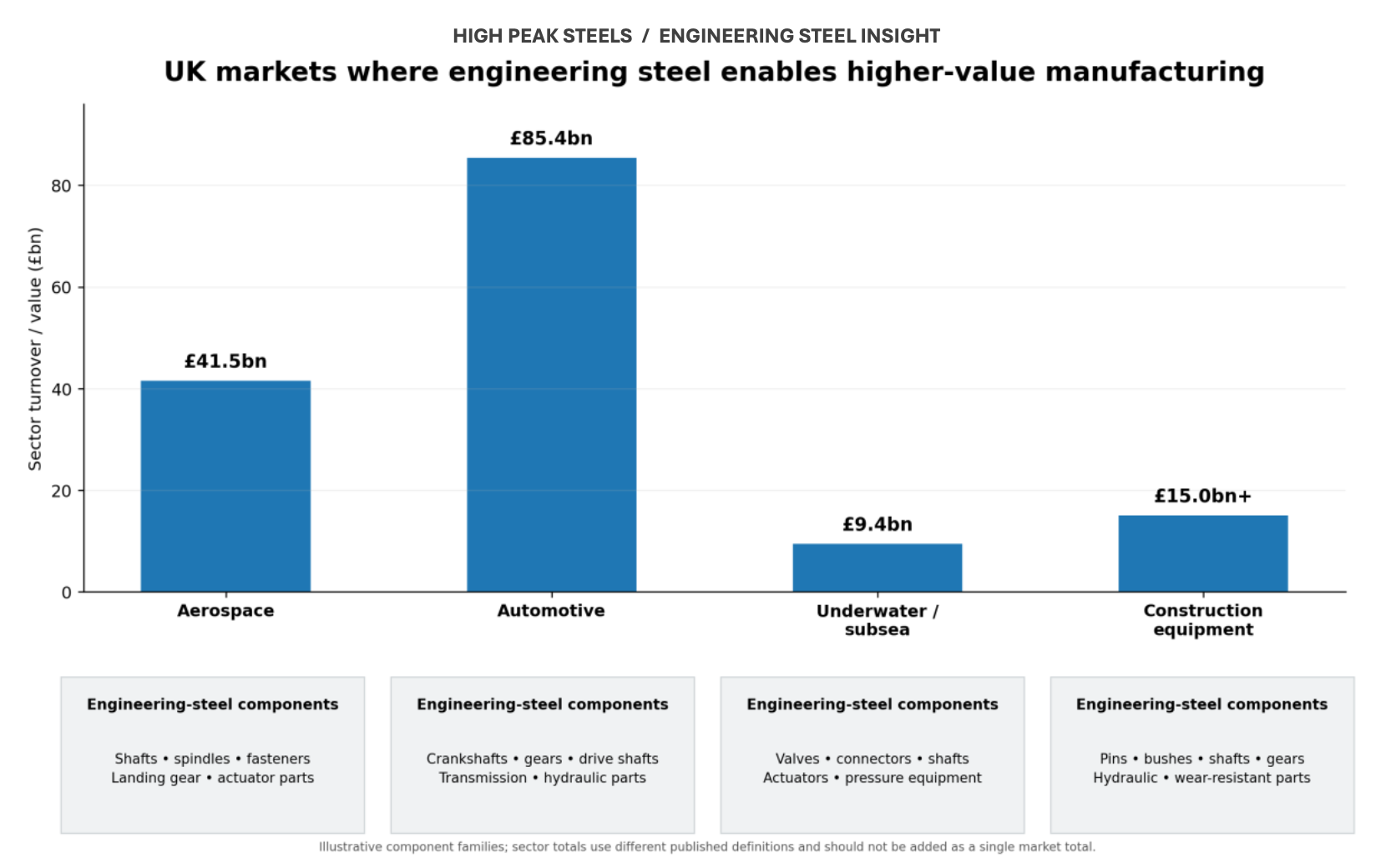
Is the UK able to manufacture the engineering steel British manufacturers need?
There is a simple way of looking at supply security.
Imagine an engineering company starting production on Monday morning. Can it telephone its steel stockholder and obtain the required grade, diameter, condition and quantity when its production schedule requires it? For many smaller engineering businesses, that is what material availability means in practice.
A steelworks may have the technical ability to produce a particular material. But unless the required product can reach manufacturers in commercially appropriate quantities and timescales, that capability does not necessarily solve today’s production requirement.
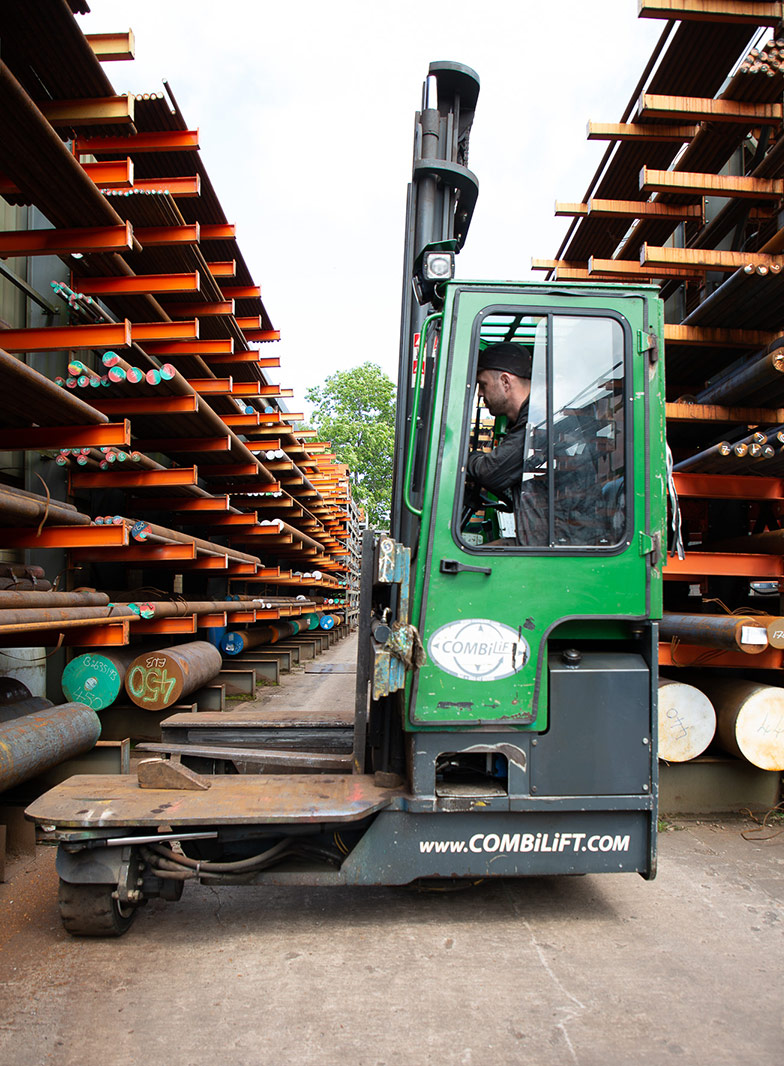
Put simply: UK engineers still need steel on the rack.
How does engineering steel create British manufacturing value?
The economic value of engineering steel does not stop when the steel is produced. Consider what can happen next:
Engineering steel → Stockholding and cutting → Machining → Heat treatment → Grinding and finishing → Inspection and certification → Assembly → Finished component or system
At every stage, additional UK skills, employment and economic value can be created. And the end markets are substantial. Aerospace, automotive, subsea, heavy equipment, defence, energy and advanced machinery all depend upon engineered components. Behind those large industries sit thousands of supply-chain companies.
Many are SMEs: precision engineers, subcontract machinists, repetition engineers, heat-treatment companies, grinders, finishers and specialist component manufacturers. This is why the question is not simply how many tonnes of steel Britain produces.
How much value can Britain manufacture from every tonne of engineering steel available to its industry?
What happens if Britain imports the component instead of the engineering steel?
This may become one of the most important questions raised by the new trade environment. Consider two possible supply chains.
Route A
Engineering steel enters the UK → UK stockholder → UK machining → UK heat treatment and finishing → UK inspection → British-manufactured component.
Route B
Steel is processed overseas → component manufactured overseas → finished or semi-finished component imported into Britain.
If the raw material required by a British engineering company becomes unavailable or commercially uncompetitive, the alternative may not necessarily be British steel. The alternative could ultimately be an imported component. That creates an important early-warning question:
Could a policy intended to strengthen British steel inadvertently make it more attractive to manufacture some components overseas?
There is not yet sufficient evidence to say that this is happening at scale. But it is something worth measuring. Falling engineering-steel imports alone would not prove policy success. We should also ask whether UK steel production increased, whether UK engineering output increased and whether imports of finished components changed.
How can British steelmaking and British engineering grow together?
This does not have to be a choice between domestic steel and imported steel. Greater viable UK production of the engineering steels British manufacturers require would strengthen supply resilience.
Where British producers can supply the necessary grade, form, quality, certification, volume and commercial availability, increased domestic production should be welcomed. Where those requirements cannot yet be met, British manufacturers still require reliable access to material. That leads to a broader policy principle:
Safeguards should protect and encourage British steelmaking where viable UK production exists, while maintaining reliable and internationally competitive access to engineering steels that UK manufacturers cannot currently source domestically in sufficient grade, form, volume or commercial availability.
Because ultimately the success of UK steel policy should be visible not only at the steelworks. It should also be visible at the machine-shop door.
What High Peak Steels is monitoring
As Q2 develops, Engineering Steel Insight will continue monitoring engineering-relevant quota utilisation, HMRC import volumes and values, evidence of out-of-quota imports, UK producer developments, stockholder availability and changes in engineering/manufacturing activity.
And we will keep asking one recurring question:
What does this mean for the UK manufacturer trying to make the component?
- Quota utilisation
- Engineering steel import volumes
- Material availability
- Lead times
- Government policy
- Market pricing
- Supply-chain resilience
We’ll also begin comparing the policy position with what we’re actually seeing in the engineering steel market. Because ultimately, policy only becomes meaningful to an engineer when it affects the engineering steel material you require to make the next order of components.
This table shows one of the measures we’ll be monitoring in our Steel Insights. You can read more about this in Chapter 3.

Finally, if your business is affected by these challenges we’d love to hear from you. Our plan is to feed genuine insights on the market; that includes you the engineering business. You can send your comments to sales@highpeaksteels.com and these will be evaluated by our Directors for inclusion in Blog content in the coming months.
Want the deeper analysis?
Delve deeper into this topic by viewing or downloading Chapter 3 of our Engineering Steel Insight.
We’ll look at the safeguard categories in greater detail, map them against engineering steel products and High Peak Steels’ stocked grades, and examine what the emerging evidence tells us about availability, sourcing and competitiveness.
Engineering Steel Safeguards: Which Grades Are Actually Affected?
As always, we will continue to monitor developments closely and keep you informed. For customers requiring engineering-grade steels such as EN8 and EN24, we continue to support supply wherever possible despite current market pressures.
To discuss any challenges you may be facing in supply, or to discuss how High Peak Steels can support you at this critical time, call us directly on 01457 866911.
Look for our latest updates on LinkedIn, TikTok, Facebook and X.